MMRInsights


Expanded Polypropylene Foam Market: Applications and Growth
The Expanded Polypropylene Foam Market has emerged as a versatile material for industries that require lightweight construction, impact protection, durability, and design flexibility. The material is increasingly used in automotive components, protective packaging, consumer products, industrial applications, and other specialized products. Its combination of physical and mechanical properties has made it an important option for manufacturers looking to balance product performance with material efficiency.
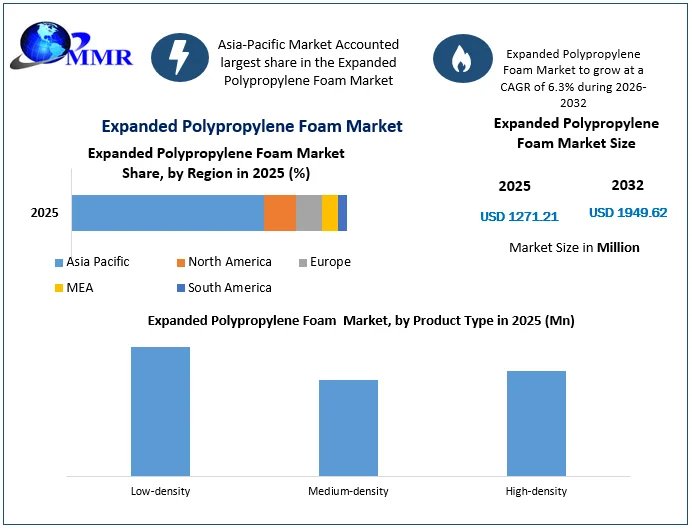
The global Expanded Polypropylene Foam Market was valued at approximately USD 1.27 billion in 2025 and is projected to reach nearly USD 1.95 billion by 2032, expanding at a compound annual growth rate of about 6.3% during the forecast period. Increasing applications of EPP foam in automotive, packaging, and consumer goods are contributing to the continued development of the market.
What Is Expanded Polypropylene Foam?
Expanded polypropylene foam is a closed-cell foam manufactured from polypropylene resin. During production, polypropylene beads are expanded and subsequently molded into different shapes and sizes. The resulting foam has a cellular structure that provides a combination of low weight, resilience, cushioning, and energy absorption.
One of the notable characteristics of EPP foam is its ability to recover after compression or impact. This makes it suitable for applications where components or products may be exposed to repeated handling, vibration, or physical stress. The material can also be produced in different densities, allowing manufacturers to select properties according to specific application requirements.
EPP foam is also resistant to moisture and can withstand exposure to various environmental conditions. These characteristics contribute to its use in both indoor and outdoor applications.
Download a Free Sample of the Market Report : https://www.maximizemarketresearch.com/request-sample/93313/
Automotive Applications Create Strong Demand
The automotive industry is one of the major application areas for expanded polypropylene foam. Vehicle manufacturers continue to explore lightweight materials that can help reduce vehicle mass while maintaining the required performance characteristics.
EPP foam can be molded into various automotive components, including bumper structures, headrests, seat components, door elements, roof pillars, armrests, and protective parts. Its impact absorption characteristics make it useful for selected applications where energy management and cushioning are important.
The material’s low density is also relevant to vehicle lightweighting. Reducing unnecessary vehicle weight can support improvements in energy efficiency, which is important for both conventional and electric vehicles. As automotive manufacturers develop new vehicle platforms, lightweight polymer materials are being considered for a broader range of components.
The development of electric vehicles is creating additional areas of interest. EPP foam can be incorporated into selected protective and insulating applications associated with vehicle systems and components.
Protective Packaging Expands Material Usage
Packaging represents another important application for EPP foam. Products transported through supply chains can encounter vibration, compression, drops, and repeated handling. Protective packaging materials therefore need to provide cushioning while maintaining their structural integrity.
EPP foam can be molded into trays, inserts, containers, cases, and customized protective structures. These products can be designed around the dimensions of individual components, helping maintain positioning during transportation.
The material is used for packaging automotive components, electronic equipment, industrial products, appliances, and other items that require additional protection. Its resilience can also support reusable packaging systems, where packaging components are used repeatedly rather than discarded after one transportation cycle.
The expansion of organized logistics and e-commerce has increased attention toward protective packaging. As products move through multiple stages of distribution, packaging manufacturers are developing solutions that combine protection, durability, and efficient material usage.
Consumer Goods Offer Additional Opportunities
EPP foam is not limited to automotive and packaging applications. The material is also used in various consumer goods because of its lightweight structure, cushioning characteristics, and ability to be molded into customized forms.
Potential applications include sports equipment, protective cases, furniture components, toys, storage products, and other molded consumer items. Product designers can use different densities and shapes to create components that provide structural support or cushioning without adding excessive weight.
The material’s surface characteristics and ability to accept different designs also provide flexibility for consumer product development. Manufacturers can create products with specific dimensions and functional characteristics depending on the intended use.
Industrial Applications Continue to Develop
Industrial applications provide another area of opportunity for EPP foam. Manufacturing facilities often require protective solutions for components, tools, machinery parts, and equipment during storage and transportation.
EPP foam can be used to create customized inserts and containers that hold industrial components securely. Its cushioning properties can help reduce the effects of impact and vibration during handling.
The material can also be incorporated into selected insulation and noise-control applications. Its closed-cell structure provides characteristics that can be useful in environments where thermal or acoustic performance is required.
As industrial manufacturing becomes increasingly automated and specialized, the need for customized material-handling solutions can create additional applications for molded EPP products.
Importance of Material Density
Different EPP foam densities can be selected according to the performance requirements of an application. Low-density products may be suitable where weight reduction and cushioning are primary considerations, while medium- and high-density materials can provide greater structural support and impact resistance.
High-density EPP foam has applications in areas where stronger energy absorption and structural performance are required. Automotive components and industrial packaging are examples of applications where higher-density materials can be useful.
The availability of different densities allows manufacturers to optimize products according to weight, strength, cushioning, and cost considerations.
Sustainability and Reusability
Sustainability is becoming increasingly important in material selection. EPP foam can contribute to material-efficiency strategies because of its lightweight construction, durability, and potential for repeated use.
Reusable EPP packaging can help reduce the need for single-use protective packaging in suitable supply-chain applications. The material can also be recycled through appropriate recycling systems, although recycling availability and infrastructure vary across regions.
Manufacturers are increasingly examining ways to improve material recovery, reuse, and recycling. These developments can influence future product design and manufacturing practices within the EPP foam industry.
Asia Pacific Represents an Important Market
Asia Pacific is an important region for the expanded polypropylene foam industry. Strong automotive manufacturing, consumer goods production, electronics manufacturing, and packaging activity contribute to demand for EPP foam products.
Countries such as China, India, and Japan have substantial manufacturing ecosystems that support applications for lightweight polymer materials. Growing industrial activity and expanding production capabilities can provide opportunities for EPP foam manufacturers and processors.
The region’s automotive sector is particularly relevant because EPP foam is used in multiple vehicle components. Increasing demand for consumer products and protective packaging also supports applications beyond automotive manufacturing.
North America and Europe remain significant markets due to their established automotive, industrial, packaging, and consumer goods industries. Manufacturers in these regions continue to explore lightweight materials and specialized molded foam solutions.
Product Development and Manufacturing Innovation
Innovation in material formulation and molding technology is expected to influence the future of EPP foam. Manufacturers are developing products with different densities, improved energy absorption, and application-specific characteristics.
Advanced molding processes can allow EPP foam to be produced in complex shapes. This gives product designers greater freedom when developing components that need to fit within limited spaces or perform multiple functions.
Improved manufacturing efficiency can also support more precise material usage. By designing components according to specific performance requirements, manufacturers can potentially reduce unnecessary material while maintaining the desired characteristics.
Future Outlook
The expanded polypropylene foam market is expected to continue developing as industries seek lightweight, durable, and adaptable materials. Automotive manufacturing, protective packaging, consumer products, and industrial applications are likely to remain important areas of demand.
The growing focus on vehicle lightweighting, reusable packaging, product protection, and efficient material utilization provides several opportunities for EPP foam applications. Advances in molding technology and material development may further expand the range of products that can be manufactured using EPP.
Overall, expanded polypropylene foam combines low weight, impact absorption, resilience, moisture resistance, and molding flexibility in a single material. These characteristics make it suitable for a broad range of applications. As manufacturers continue to develop products that require efficient use of materials without compromising functionality, EPP foam is expected to remain an important material across automotive, packaging, consumer goods, and industrial sectors.